"Waiting - Again."
Mixed Media, 36x48"
$850
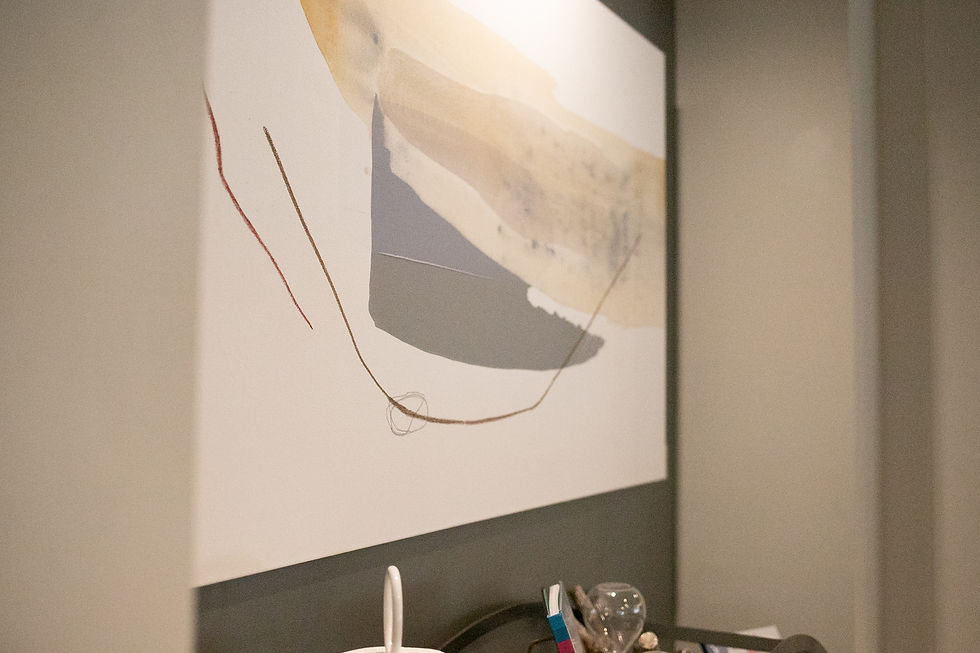
Waiting — Again is about the kind of waiting that changes you.
Not the impatient kind of waiting where you simply want something to happen, but the deeper kind—the waiting that asks you to surrender your own timeline. The waiting that leaves you wondering if you misunderstood the promise, if you are behind, or if everyone else somehow received the things you have been praying for while you are still standing in the same place.
There is peace in this painting, but it isn’t an uncomplicated peace. It is the peace that exists alongside questions.
There is a longing to receive—to finally put down the strength that has been required for so long and allow something good to come to you. A longing to stop having to be strong, to stop having to carry, to stop having to figure everything out. And yet, there is something quietly beautiful about realizing that the strength built during the waiting was never wasted.
I don’t want to romanticize the struggle. There are moments when I am tired of carrying my own strength. Tired of being resilient. Tired of having to believe that something beautiful is coming when I cannot see it yet.
But somewhere in the waiting, I have begun to understand that waiting isn’t necessarily emptiness.
Maybe it is preparation.
Maybe it is where comparison loses its grip.
Maybe it is where trust becomes deeper than certainty.
Maybe it is where I learn that receiving is also a form of surrender.
Maybe it is where God is doing work I cannot see yet.
This painting holds the tension between “How much longer?” and “I trust You.”
Between wanting and releasing.
Between grief and gratitude.
Between the strength I have built and the strength I am finally willing to lay down.
And underneath all of it is peace.
Not because I have every answer, but because I am beginning to believe that I don’t need them.
The waiting has taught me things I could not have learned by arriving early.
So I wait.
Again.
Not as the same person I was before, but as someone who has grown through every season that brought her here.
And maybe that is the quiet gift of waiting: realizing that while I thought I was waiting for my life to begin, God was teaching me how to live it.
PS:
Hey mom,
I wrote this next section for you to explain each mark.
The marks in Waiting — Again are meant to feel like a visual record of the emotional process of waiting—not just the large painted forms, but the small, restless marks that move across and through them.
They hold the tension between movement and stillness, hope and uncertainty, effort and surrender.
The long, thin brown-red line feels like the strongest symbol of time and movement. It begins almost abruptly at the left, travels downward and across the painting, and eventually stretches toward the right. But it doesn't move in a straight or confident path. It wanders, changes direction, and seems to search for somewhere to go.
That feels like waiting to me.
You are still moving. Life is still happening around you. You are growing, making choices, becoming someone new—but you don't necessarily know where the path is taking you. There is movement without certainty. Progress without knowing what you're progressing toward.
The line also feels like time itself: long, continuous, and impossible to stop. You can move with it, but you cannot control its pace.
Near the bottom, the line doubles back on itself and creates a small loop or knot. This feels like the repetitive nature of uncertainty. When you have been waiting for something long enough, the same questions can begin circling in your mind:
How long? Why not yet? Did I misunderstand? Am I supposed to keep waiting? Did I somehow miss what I was supposed to do?
The line doesn't simply move forward—it returns to itself.
That small knot feels like what happens when questioning becomes repetitive. You think you are searching for an answer, but sometimes you are simply moving around the same uncertainty again and again.
Then there are the gray and black hatched marks in the lower right. They feel much more deliberate and contained than the wandering line. They look like an accumulation of tiny strokes—small efforts repeated over time.
They feel like endurance.
There is something about them that says, I have carried this for a long time.
Unlike the wandering line, these marks are controlled. They represent the strength that develops simply because you have had to keep going. Not dramatic strength. Not the kind that announces itself. The quieter strength of continuing when there is no clear evidence that the waiting is ending.
They remind me that waiting asks something of us.
Patience.
Discipline.
Trust.
And sometimes, simply the willingness to wake up and continue living while the answer remains unknown.
The blue and lavender shapes are the emotional quiet underneath everything else. They are soft and atmospheric, almost as though they exist beneath the surface of the more obvious struggle.
I see them as peace.
But not the kind of peace that comes after the longing has disappeared.
They feel like peace that exists while the longing is still there.
That distinction is important to me. I can still want something deeply and experience peace at the same time. I can still have unanswered questions and feel held. I can still wish for something to change without believing that my life is empty until it does.
The peace is underneath the waiting.
The faint gray smudges within the large cream-colored form make the painting feel intentionally unresolved. The surface isn't completely clean. There are traces of what came before—memories, disappointment, confusion, old questions, moments that haven't completely disappeared.
But they are different from the darker marks.
They have been partially absorbed into the lighter form.
They are still visible, but they no longer dominate it.
That feels like the way time changes our relationship with what we've carried. The past doesn't necessarily disappear. Instead, it becomes woven into the larger story. What once felt defining can eventually become something we can look at without being consumed by it.
And then there is the large pale horizontal form stretching across the top.
It feels almost like something being held above you—an unanswered promise, a possibility, a future that you can sense but cannot quite reach.
It isn't heavy.
It doesn't feel threatening.
It feels expansive and soft.
That changes the feeling of the waiting.
It doesn't make it feel like punishment.
It makes it feel mysterious.
There is something beyond what I can currently see, but I can't force myself to reach it before its time.
And perhaps that is where faith enters the painting—not as certainty, but as the willingness to remain open to what I cannot yet understand.
The marks don't stay neatly inside the boundaries of the painted forms.
The wandering line moves out into the empty space.
The waiting isn't contained neatly inside one part of life.
It spills outward.
It affects how I think, what I hope for, how I compare myself to other people, how I understand God's timing, and how I imagine what comes next.
It occupies the spaces between things.
But the line keeps going.
It doesn't end at the knot.
It doesn't disappear into the darkness.
It continues across the canvas.
And I think that is where I see the quietest form of hope in this painting.
The waiting may change direction.
It may circle back.
It may become exhausting.
It may ask the same questions over and over.
But it does not stop me from moving.
I am still becoming while I am waiting.


Comments